
I didn't vote in the presidential election. Yes, I know, I should be ashamed of myself. I like to say it was because I didn't apply for my absentee ballot on time, but that was only because I was too apathetic to look up the deadline. And so I sat out on my first election since turning eighteen.
If I could have voted when I was ten, I would have been a Democrat. I soaked in the videos they showed at school, the ones that exhorted us to write our senator and tell him to save the otters or ozone or oceans. I read books where the heroine struggles against a patriarchy which wants to keep her from becoming a knight/mage/writer just because she's a girl, and I felt awful outrage on her behalf. My mission, then, was to take down the Man.
By thirteen, I had morphed into a staunch Republican. I read conservative blogs obsessively. My favorite were social-conservative posts detailing the outrageous liberal offenses of NOW or NEA or a whole host of other acronyms.
And then, when I was finally old enough to actually participate in the political process, the thought of voting for either Obama or McCain made me feel a little annoyed, a little queasy, and a lot tired. I couldn't even tell which was the lesser of two evils. I sort of wish I'd voted Libertarian, but I haven't lost sleep over it.
I think my partisanship died along with my love of being offended. I haven't felt righteous indignation in years. Nowadays my list of Things You Should Never Do When Angry includes posting anything anywhere on the Internet, ever, and voting.
Monday, February 16, 2009

Thursday, February 12, 2009
Humor
To me, humor is like photography. I say as many off-kilter things as I possibly can, and people only remember the 5% they find funny.
Tuesday, February 10, 2009
Truth and Freedom
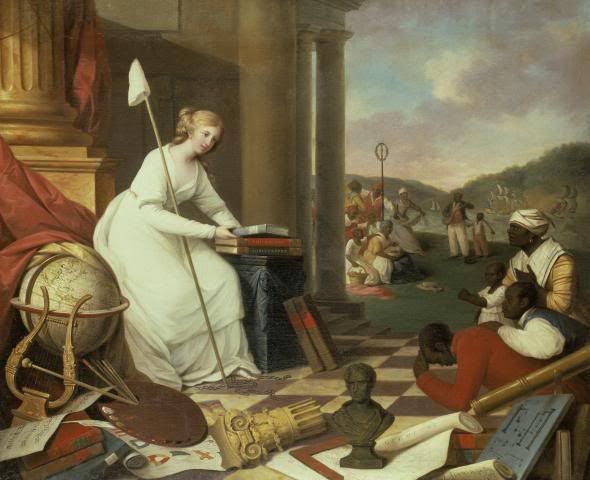
I found this painting in my Government textbook. It's called "Liberty Displaying the Arts and Sciences," and was commissioned by an abolitionist society in the late 1700's, and shows the personification of Liberty displaying books to freed slaves.
This painting struck a chain reactions of associations with me. It reminded me of "And ye shall know the truth and the truth shall make you free." This, in turn, reminded me of my Chemistry teacher on the first day of class, who quoted Mormon Scientist, the biography of Henry Eyring. "We are required to believe every true thing," said my teacher. And this made me think of the Darwin Week posters plastered all over the Marb, advertising lectures titled "An Approach to Understanding the Creation" and "The Legacy of Charles Darwin: Seeking Grandeur in the View of Life." Then I remembered my rural Mississippi high school, filled with noise and the built-up resentment of four-hundred students.
Then I realized I strayed far from the topic of slavery in post-Revolution America, which was what my reading was actually about and what I had to take a quiz on. I wish I could better articulate the significance all those linked words and images have to me. Suffice it to say, I believe in fighting tooth and nail for an education. And I believe (or maybe I say it because it sounds nice, I'm not sure) that truth and liberty are inextricably connected, and that people need them both like water.
Saturday, January 31, 2009
Abomination!
We watched two movies in my science fiction film class this week, The Invisible Man and The Bride of Frankenstein. Both movies have the same, clear-cut message.
There's the moment at the end of The Invisible Man when said man lies in a hospital bed, dying, as his beloved Flora holds his hand. He tells her something along the lines of "I meddled in things Man is not supposed to know," and dies. The chemical mixture which turned him invisible, you see, also turned him mad, and he went about most of the movie murdering and causing mayhem.
But here's the thing... Another scientist character had read an article in an obscure German journal about the dye on which the invisibility chemical was based. In that experiment, the dye was injected under the skin of a dog. The dog went raving mad. So if the Invisible Man had, while still a Visible Man, either asked his supervisor for advice on his experiment or decided to try it on a hamster first, everything would have been fine.
In The Bride of Frankenstein, Mary Wollstencraft Shelley explains to Percy Shelley and Lord Byron (seriously) that "The publishers did not see that my purpose was to write a moral lesson. The punishment that befell a mortal man who dared to emulate God." Later, Henry Frankenstein lies in a bed after nearly dying, while his beloved Elizabeth holds his hand. He muses to her that perhaps he could find the secret to eternal life. She exclaims "Henry, don't say those things. Don't think them. It's blashpemous and wicked. We are not meant to know those things."
But elsewhere in the movie the monster meets an old, blind man and becomes his friend. This man teaches the monster to talk in a stunted, Tarzan-like way, showing that the monster is intelligent and self-aware. He only goes on the rampage again when some hunters show up and are, like, "Agh, the monster! Kill!"
In the original book, Frankenstein, the moral was even more clear. Mary Shelley subtitled the book Modern Prometheus, and she clearly didn't like Prometheus, who stole fire from the gods. And yet even in that book, the monster only starts getting all rampage-murder-y to get his revenge on his creator, who rejected him because of his hideousness. And he even learns to talk well and clearly. The monster in the book is outright articulate.
So if everyone had just been nice to the monster, everything would have been fine!
To me, the moral is less "Don't meddle in things man is not meant to know" than "Don't meddle incompetently."
There's the moment at the end of The Invisible Man when said man lies in a hospital bed, dying, as his beloved Flora holds his hand. He tells her something along the lines of "I meddled in things Man is not supposed to know," and dies. The chemical mixture which turned him invisible, you see, also turned him mad, and he went about most of the movie murdering and causing mayhem.
But here's the thing... Another scientist character had read an article in an obscure German journal about the dye on which the invisibility chemical was based. In that experiment, the dye was injected under the skin of a dog. The dog went raving mad. So if the Invisible Man had, while still a Visible Man, either asked his supervisor for advice on his experiment or decided to try it on a hamster first, everything would have been fine.
In The Bride of Frankenstein, Mary Wollstencraft Shelley explains to Percy Shelley and Lord Byron (seriously) that "The publishers did not see that my purpose was to write a moral lesson. The punishment that befell a mortal man who dared to emulate God." Later, Henry Frankenstein lies in a bed after nearly dying, while his beloved Elizabeth holds his hand. He muses to her that perhaps he could find the secret to eternal life. She exclaims "Henry, don't say those things. Don't think them. It's blashpemous and wicked. We are not meant to know those things."
But elsewhere in the movie the monster meets an old, blind man and becomes his friend. This man teaches the monster to talk in a stunted, Tarzan-like way, showing that the monster is intelligent and self-aware. He only goes on the rampage again when some hunters show up and are, like, "Agh, the monster! Kill!"
In the original book, Frankenstein, the moral was even more clear. Mary Shelley subtitled the book Modern Prometheus, and she clearly didn't like Prometheus, who stole fire from the gods. And yet even in that book, the monster only starts getting all rampage-murder-y to get his revenge on his creator, who rejected him because of his hideousness. And he even learns to talk well and clearly. The monster in the book is outright articulate.
So if everyone had just been nice to the monster, everything would have been fine!
To me, the moral is less "Don't meddle in things man is not meant to know" than "Don't meddle incompetently."
Friday, January 30, 2009
Yagh! Going down...
There is a moment, every time I fall, when I've passed the balancing point, and feel gravity getting to me. Even though the rush to the floor hasn't quite begun, I know, at this point, that there's nothing I can do to stop it, and can only try to make the way down as graceful as possible.
I fall a lot, especially since I moved out here and, for the first time in my life, there's enough snow to pack into a slippery death trap on the sidewalks. Every time I slip, and have that moment of resignation, I think it would make a great life metaphor. But I don't have any actual life experience to match the metaphor, so I stash it away with my other half-metaphors, all waiting for me to live the life part.
I fall a lot, especially since I moved out here and, for the first time in my life, there's enough snow to pack into a slippery death trap on the sidewalks. Every time I slip, and have that moment of resignation, I think it would make a great life metaphor. But I don't have any actual life experience to match the metaphor, so I stash it away with my other half-metaphors, all waiting for me to live the life part.
Wednesday, January 28, 2009
Obnoxious and Disliked
John Adams is my favorite founding father.
I wish I had formed this opinion thoughtfully, after considering his lifelong devotion to his wife and to God, his opposition to slavery, etc. He's certainly less confusing than Thomas Jefferson. But really, it's all because of 1776.
Growing up, we watched the musical every fourth of July. I realize that it isn't the most historically accurate retelling of the writing of the buildup to American independence--the characters are distorted to make heroes and villains and comic relief, exaggerated in the style of any self-respecting musical extravaganza.
And yet, still, when John Adams sings Is Anybody There at the climax--"I see Americans - all Americans / Free forevermore"-- it embodies every fuzzy, patriotic feeling I've ever had.
We watched part of the John Adams mini-series in Government, and it made me think about historical fiction. We watched the part of the mini-series covering the Declaration of Independence, and I'm sure it was far more factual than the musical. John Adams the series is based on John Adams the intensely researched book by David McCullough. That is one of those books, by the way, which everyone claims to have read. I read the beginning of the book and really did enjoy it, though I still trailed off right around the Boston Massacre. However, if the topic of the book ever comes up, I make sure to widen my eyes and say, "Oh, that's a great book, you need to read it," implying I devoured it from cover to cover.
So, obviously, John Adams was more factual than 1776. I was especially struck by the different interpretations of John Dickinson. In the musical he is pompous and unlikeable, and his Quaker religion isn't mentioned once. In the mini-series he's soft-spoken, his speeches heartfelt, and a large part of his opposition to independence is attributed to Quaker pacifism. He's still the antagonist, but he's not a villain at all.
But John Adams is still fictionalized. The film-makers had to make up all sorts of things, little snippets of dialogue and the precise tone of voice in which Benjamin Franklin delivers his famous witticisms and the look on everyone's face. Therein, I think, lies the value of historical fiction. It helps you believe that the people in history books were, in fact, real people.
I sometimes have the feeling that the world didn't exist before the early 90's, which is when I start to remember it. This is related to the feeling that the world doesn't exist outside your home town/state/country, or even that you are the only real person in the world. These are all bad, foolish feelings, dangerous even. And if I actually see Abigail Adams holding her child while he's inoculated against small pox, it's easier to feel that she really lived, and by extension so did the rest of the long-ago world.
This holds true even if, afterwards, she gets up and sings.
I wish I had formed this opinion thoughtfully, after considering his lifelong devotion to his wife and to God, his opposition to slavery, etc. He's certainly less confusing than Thomas Jefferson. But really, it's all because of 1776.
Growing up, we watched the musical every fourth of July. I realize that it isn't the most historically accurate retelling of the writing of the buildup to American independence--the characters are distorted to make heroes and villains and comic relief, exaggerated in the style of any self-respecting musical extravaganza.
And yet, still, when John Adams sings Is Anybody There at the climax--"I see Americans - all Americans / Free forevermore"-- it embodies every fuzzy, patriotic feeling I've ever had.
We watched part of the John Adams mini-series in Government, and it made me think about historical fiction. We watched the part of the mini-series covering the Declaration of Independence, and I'm sure it was far more factual than the musical. John Adams the series is based on John Adams the intensely researched book by David McCullough. That is one of those books, by the way, which everyone claims to have read. I read the beginning of the book and really did enjoy it, though I still trailed off right around the Boston Massacre. However, if the topic of the book ever comes up, I make sure to widen my eyes and say, "Oh, that's a great book, you need to read it," implying I devoured it from cover to cover.
So, obviously, John Adams was more factual than 1776. I was especially struck by the different interpretations of John Dickinson. In the musical he is pompous and unlikeable, and his Quaker religion isn't mentioned once. In the mini-series he's soft-spoken, his speeches heartfelt, and a large part of his opposition to independence is attributed to Quaker pacifism. He's still the antagonist, but he's not a villain at all.
But John Adams is still fictionalized. The film-makers had to make up all sorts of things, little snippets of dialogue and the precise tone of voice in which Benjamin Franklin delivers his famous witticisms and the look on everyone's face. Therein, I think, lies the value of historical fiction. It helps you believe that the people in history books were, in fact, real people.
I sometimes have the feeling that the world didn't exist before the early 90's, which is when I start to remember it. This is related to the feeling that the world doesn't exist outside your home town/state/country, or even that you are the only real person in the world. These are all bad, foolish feelings, dangerous even. And if I actually see Abigail Adams holding her child while he's inoculated against small pox, it's easier to feel that she really lived, and by extension so did the rest of the long-ago world.
This holds true even if, afterwards, she gets up and sings.
Sunday, January 25, 2009
Ion Means Wanderer
For my first two years of high school, I never ate lunch. The cafeteria was chaotic and greasy, and I preferred to spend my lunch hour in the library where I would chat with Mr. Brown, fiddle around the Internet, read in the corner, or wander through the stacks looking at titles.
That was how I first found Atom: Journey Across the Subatomic Cosmos by Isaac Asimov.
The book is, essentially, a history of the discovery of the atom and its associated bits, describing each theory and experiment along the way in layman's terms. So it was written for laymen, but not fourteen-year-olds, and though the book fascinated me, it flew straight over my head.
Since then I've taken my first actual science classes. This past week I looked Atom up in the BYU library, and have been reading it. And I follow it now, I do. It makes me feel so grown up.
Things I like about Atom: 1 - Asimov gives the Greek origin for scientific terms, which is mostly obvious but sometimes interesting. 2 - He pays a lot of attention to scientists as people, especially how their human failings affect the course of scientific discovery. 3 - He details the ways atomic theory developed, from philosophizing to equations to experiments, and uses this to talk about theories in general, what they're for and what they mean. 4 - He carefully explains the exact mechanisms of experiments and the circumstances of accidental discoveries, which helps you to follow the thought processes of all those dead scientists.
I don't know all the details of atomic theory that have changed since Atom was published, and in fact the book so far has made no mention of orbitals or electron clouds, leaving me with the impression of electrons traveling in waving loops around the nucleus. Still, it's a clearly written interesting, history of physics and I like it.
That was how I first found Atom: Journey Across the Subatomic Cosmos by Isaac Asimov.
The book is, essentially, a history of the discovery of the atom and its associated bits, describing each theory and experiment along the way in layman's terms. So it was written for laymen, but not fourteen-year-olds, and though the book fascinated me, it flew straight over my head.
Since then I've taken my first actual science classes. This past week I looked Atom up in the BYU library, and have been reading it. And I follow it now, I do. It makes me feel so grown up.
Things I like about Atom: 1 - Asimov gives the Greek origin for scientific terms, which is mostly obvious but sometimes interesting. 2 - He pays a lot of attention to scientists as people, especially how their human failings affect the course of scientific discovery. 3 - He details the ways atomic theory developed, from philosophizing to equations to experiments, and uses this to talk about theories in general, what they're for and what they mean. 4 - He carefully explains the exact mechanisms of experiments and the circumstances of accidental discoveries, which helps you to follow the thought processes of all those dead scientists.
I don't know all the details of atomic theory that have changed since Atom was published, and in fact the book so far has made no mention of orbitals or electron clouds, leaving me with the impression of electrons traveling in waving loops around the nucleus. Still, it's a clearly written interesting, history of physics and I like it.
Subscribe to:
Posts (Atom)